Tapiola’s Forbidding Forest music
A tall, mustached man strolls through the flat landscape alone. Pausing occasionally to look about him, he listens to the songs of the birds, or the sweep of the wind on the land. The peaty low-clinging alpine grasses collapse under his feet as he weaves his slow way through the wandering maze that marshland always produces. In the past, walking here has helped him to organize his thoughts, particularly around his favorite themes: the dignity and vitality of the Finnish people and culture, and how to best to express this culture in music.
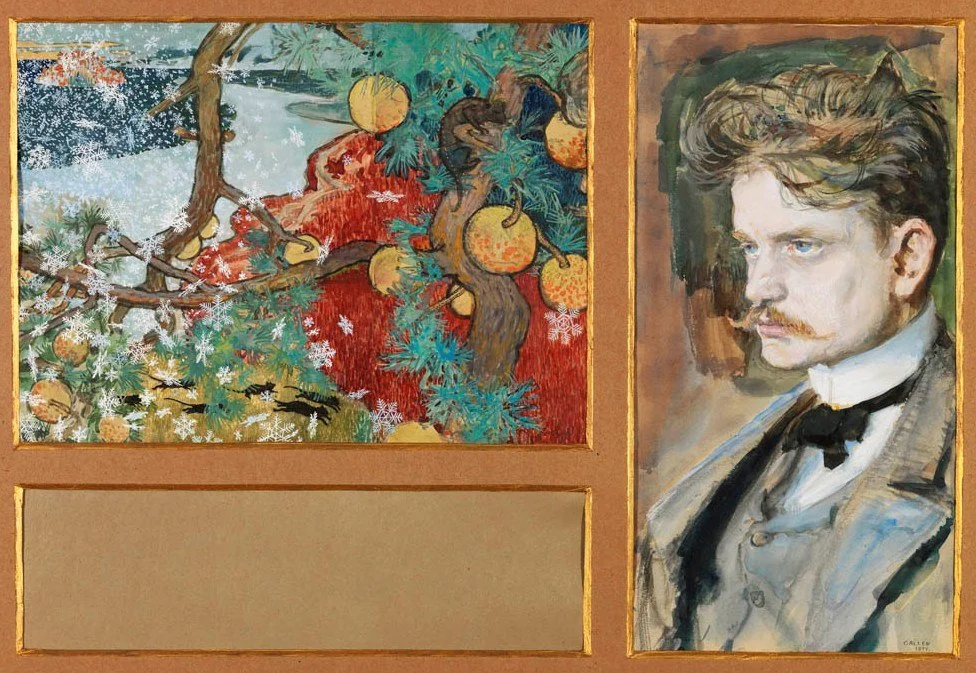
Akseli Gallen-Kallela’s 1894 portrait of the composer, called En Saga: Jean Sibelius and Fantasy Landscape. The bottom left rectangle of the painting was supposed to include notes from Sibelius’s famous 1892 tone-poem En Saga, or “A Fairy Tale,” but Sibelius declined to share them. Like Sibelius, Gallen-Kallela was inspired by many parts of the Kalevala, painting many famous scenes from the folk epic.
In an age of cosmopolitan elaboration, Jean Sibelius offered the world something totally different. It is enlightening to consider Ravel’s elaborate, impossibly intricate orchestral music, sophisticated and urbane beside what Sibelius did. While Ravel was assembling his meticulous scores, Schoenberg was manipulating harmony in increasingly radical ways, and Stravinsky was shocking the world with his bizarre musical experiments, Sibelius went au naturel. When we listen to the music of Sibelius, we hear nature itself. For whatever reason, I can’t listen to his beloved violin concerto, without picturing in my head the icy north. And the majestic second and fifth symphonies always take me to the top of mountains, enjoying the breathtaking views at the summit. And these are more than my own idiosyncratic reactions to his music, it’s almost universal. Overwhelmingly, musicians and listeners hear nature itself in his music, describe it using natural imagery.
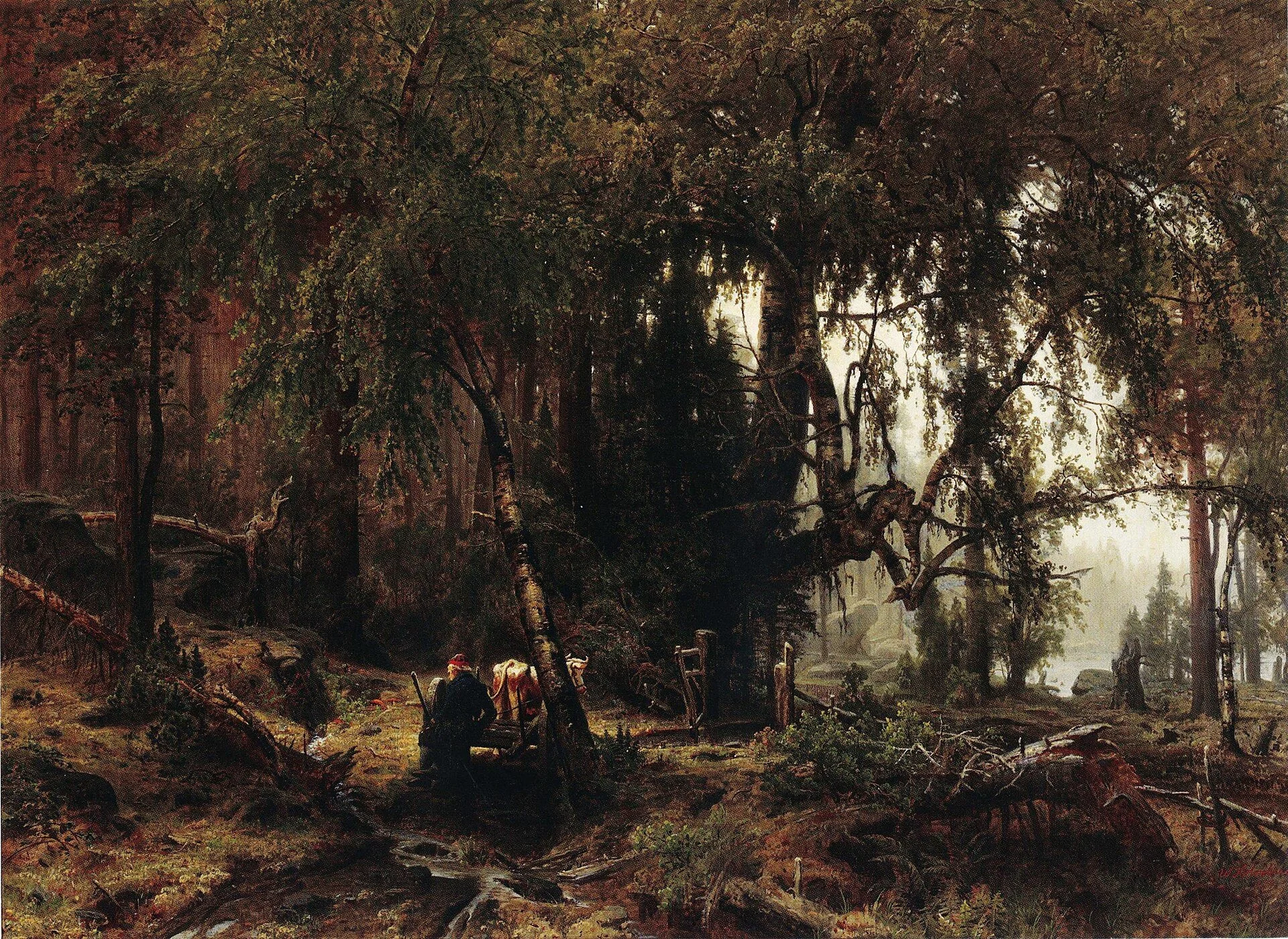
Werner Holmberg’s 1859 painting Metsä sadeilmalla or “Forest in Rainy Weather.” Finland’s beautiful nature had inspired many skilled landscape painters, longer before the cultura renaissance of the late 19th century, of which Jean Sibelius was perhaps the most important figure.
Sibelius’s music always seems to depict the natural world, but rarely in a strictly literal way. Not quite “the flute is a bird,” “the strings are a brook,” but rather, a naturalness, a natural simplicity, predominates. Supposedly Sibelius said that while most composers of his time offered the public increasingly elaborate cocktails he offered them “ice-cold spring water.” I can’t help but hear mountains in his music, marshes, boulders, sunsets, birds, bears and bees. Lakes, rivers, streams, leaves rustling, light reflecting against the snow, moss collapsing underfoot, a sheet of ice collapsing, tall trees looming overhead. It’s an odd thought, that this is the sound a branch or a boulder would make, if it had a voice of its own, but Sibelius somehow invites these questions.
But his depictions of nature aren’t always celebratory or comforting. A cold, impersonal, impassive view of nature also finds expression in his music. I hear this especially in his austere fourth symphony, which is hard and unyielding, somewhat nihilistic, but not emotional enough to be “tragic.” It is unfeeling cosmic indifference, Darwinian atheistic apathy à la Jack London. His last completed symphony, his seventh, gloriously fuses these two “sides” of nature. In one continuous movement, it grows to a majestic conclusion, but somehow, in its relentless earnestness, it is highly unsettling. Grand on the surface, but deep down conveying a strange anxiety that is difficult to put into words. Like a bear in a cage, it inspires both awe, respect, and fear. It powerfully demonstrates how feelings of awe often contain in them feelings of our own littleness, our own vulnerability, and our own mortality.
Shortly after the seventh symphony, Sibelius composed his last major work, the sublime tone-poem Tapiola, chilling and primal. Like the seventh symphony, the work is twenty minutes long, in one movement for full orchestra. He named it after Tapio, the spirit king of the forest throughout the Finnish folk-epic the Kalevala. When asked by his publisher to clarify what the piece is about, Sibelius responded with a short explanation that his publisher adapted into a pithy little poem in English:
Wide-spread they stand, the Northland’s dusky forests,
Ancient, mysterious, brooding savage dreams;
Within them dwells the Forest’s mighty God,
And wood sprites in the gloom weave magic secrets.
As this poem beautifully captures, Tapiola is more of a mood-piece. There is really no story here: instead, just music that is “wide-spread,” “dusky,” “ancient,” mysterious,” “brooding” “mighty,” full of “gloom” and “magic secrets.” The unease is more open and tangible here than in the fourth or seventh Symphonies, more theatrical even. It creates a feeling of suspense that hints towards horror but never truly arrives there, making it somehow even more disturbing.

Another Werner Holmberg painting, his 1854 Suomalainen järvimaisema, or “Finnish Lake Landscape.” Lakes are a prominent part of southern Finland, which has over 180,000 lakes that are over 500 square meters.
The piece begins with an ominous tympani roll, before introducing what is in fact the sole melody of the piece. Tapiola is often cited as a piece that is “monothematic,” developing a single short melody from start to finish, a feat that only a master-composer can accomplish convincingly. After a stormy, tormented introduction, the music relaxes. A long section with bassoons rocking back and forth, the same four note phrase, where the other instruments, pass around the sole “melody” of the piece, moving up, and then down, and then up again. Whenever I listen to this section I think of the strange rhythm of wind on grass or trees, leaves gently swaying one way, and then the opposite way, and then the first way again. The section goes on for a while, but it doesn’t bore, Sibelius enlivens things with meaningful variations, reminding me of my own experience on a forest hike. It’s not exactly unending variety, is it? Variations on a theme, rather. The music becomes agitated (spritely, as in the poem), as the forest has its own spirit of bustling activity, growing and then collapsing again into a pleading section with just strings. Rich string chords, huge range, incredibly dense harmonies. Throughout Sibelius beautiful plays with contrasts in range, high violins, high flutes and then suddenly a loud low chord. Eventually the music grows and grows to a climax, a great storm. The feeling is one of vastness and inevitability, and while unsettling, is not emotional enough to feel tragic. It comes across as dangerous, and sort of unfeeling, like encountering something inevitable, unmovable, and indifferent to us. Like a slow-moving tidal wave or avalanche coming to engulf us, something that doesn’t trigger anxiety as there is nothing to be done about it.
The transmission of experience and feeling here has always unsettled me; I feel it in my blood and bones. Listening to the piece feels like walking through a remote forest alone, hours and miles from another human soul, or any sign of civilization. When I listen to it, I almost feel tapped into the genetic memories of my distant ancestors, hundreds or even thousands of years ago, where the forest was a place of opportunity, where food can be found, but also a place of danger. It makes me think of Humbaba from the Epic of Gilgamesh, guardian of the cedar forest, or of the manticore of myth, human face on a beast’s body, waiting to ambush and devour the solitary traveler. It reminds me of a sensation that I have often gotten when I am out hiking, the sudden chilling feeling, that I am not alone, but am being watched. Civilizations on every continent, even in very isolated places, have imagined (discovered?) their wildernesses populated by sentient non-human beings, their elves, nymphs and fairies. Sometimes these spirits live in or simply are things we can see, like trees or rivers, other times they are invisible, only revealing themselves to us when they want to, or are surprised unawares. Like humans, these creatures can be benevolent, indifferent to us, or even malicious.
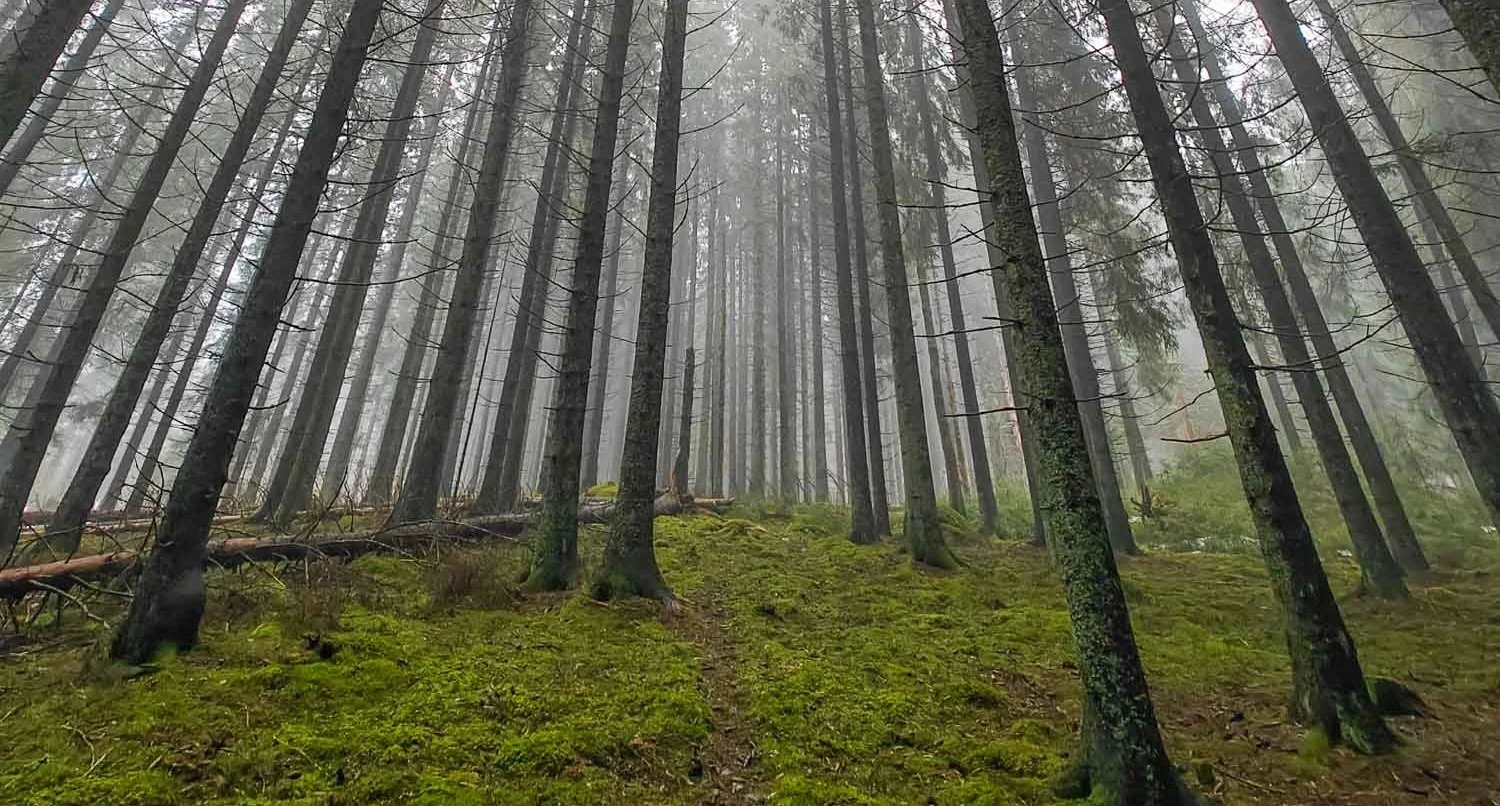
A photograph from a spruce forest in southern Finland. Finland is one of Europe’s most densely forested countries, with forest covering roughly three quarters of its land area. In Finnish mythology, forests are not only landscapes but inhabited by spirits and powers, like the spirit-king Tapio.
And when I listen to Tapiola, I feel this precise unease, this feeling of being somewhere remote, no human in sight, but not alone. It’s amazing that an orchestral piece, can give you this precise feeling, and so strongly, and in such a civilized place like a concert hall, not only around many other people, but tangibly around centuries of cultural tradition and development. The transmission of experience and feeling is unlike almost anything I have ever encountered in any work of art, and of such a specific anxiety!
By naming the piece after Tapio in the Kalevala, Sibelius gives us an interesting reason for this anxiety: the feeling of trespassing. Tapio is the spirit-king of the forest: they are his home and hunting-grounds. Thus, for the Kalevala, Sibelius and Tapiola, the remote forest is not something that belongs to everyone and no one. When we listen to this piece, the forest that we (as listeners) are walking through, it belongs to someone, it belongs to someone powerful, mysterious, and unseen. And thence our venturing through the forest, it becomes an act of trespassing, in its way, complete with the vague sense of guilt and shame that comes with it. It is interesting to consider the ways in which being watched triggers self-consciousness and the question “have I done something wrong.” Like being in a store, and noticing that the security guard is watching you closely.
By imagining the remote forest as populated by a powerful primal deity, Sibelius bucks the trends of the mid-1920’s, which was dominated by art that was social, cosmopolitan, technological and naturalistic (but naturalistic in a social way, not a nature way). Tapiola premiered in 1926, and even then, the world was still reeling from the devastating loss of optimism caused by the first world war. Think of T. S. Eliot’s The Waste Land of 1922, and its powerful expression of the spiritual and cultural exhaustion of the time. The dominant romanticism of the late nineteenth and early 20th century, as represented by Mahler and Richard Strauss, was in decline. Romantic optimism in decline, faith in religion in decline, a love of the natural world moving from someone like Wordsworth with his ideas of the positive effects of nature on the individual, to someone like Darwin, where nature is our scourge and master, and sets our limits, and is ultimately indifferent to us. Schoenberg was beginning to develop the twelve-tone technique, an abstruse “completion” of Wagnerian romantic harmonic ideas, but one that never attained widespread appeal. Hindemith was developing his musical ideas, that came to be called Gebrauchsmusik, utilitarian, social music, music for a specific purpose or event, free of the romantic idea of “art-for-art’s sake.” In Russia, inspired by the ideals of the communist party, composers were developing what was called new-wave futurism, the music of heavy industry, of technological progress, the proletariat. And is it at precisely this moment in history, into this social, godless world, that Sibelius chooses to take us to the remote wilderness, and to introduce us to a deity that’s been here the whole time? It is extraordinary. I’ve often felt that in many ways, the closest parallel works to Tapiola are works by Dvorak written 25 years earlier, like The Water Goblin, and The Noon Witch, large-scale tone-poems that tell a highly nationalistic story. But even in 1900 these works were sort of old-fashioned. Tapiola was written after Berg’s Wozzeck, after Schoenberg’s Five Pieces for Orchestra, after Stravinsky’s Rite of Spring, and after Honegger’s Pacific 231. Tapiola is Sibelius almost saying that the old gods still matter, that their domain, the natural world, should still figure into the lives of men in crowded cities.
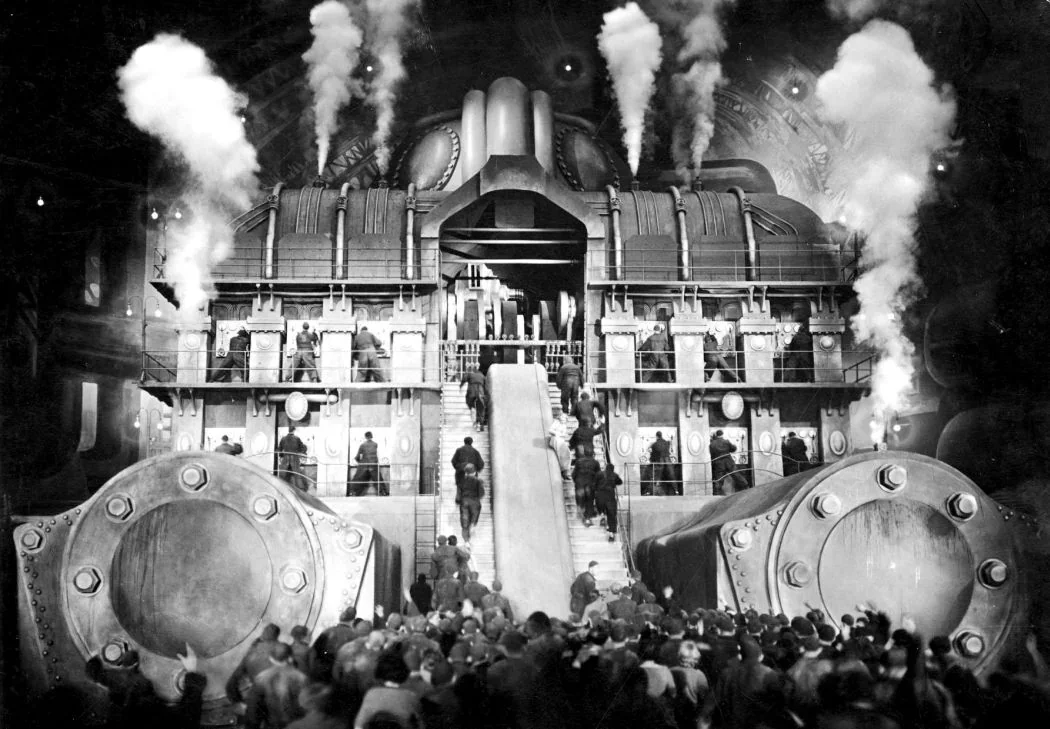
A still from the Fritz Lang’s 1927 film Metropolis. The landmark German film embodied the technological imagination of its age, looking toward a mechanized future and away from the world that had preceded it. By contrast, Tapiola (incidentally premiered a mere fifteen days (!) before Metropolis) looked backward, to an ancient past, bucking the trends of the mechanistic age it was written in.
In one way however, Tapiola conforms to the music and art of the time, its deep pessimism, which make the work itself an alternative modernist mode. And in this sense, the work is really quite special. Imagine if other composers of the twentieth century had gone along this line? Connected themselves to the ancient myths, the ancient gods, but found modern ways to express them. In trying to think of works like this, I am reminded of works like Moses und Aron, Stravinsky’s Oedipus Rex or perhaps the Cunning Little Vixen by Janacek, thoroughly modern in their idiom, but expressions of something ancient and cultural. Moses, Oedipus, the Vixen, and Tapio, all have something to say, even to civilized modern man.
Whenever I listen to Tapiola, in addition to thinking about my forest walks, I think about Sibelius, walking in the forest around his home, to clear his mind and untangle his compositional knots. By 1926, Sibelius was 60 and had already obtained unheard-of success. So many masterpieces, seven symphonies, the violin concerto, the choral symphony Kullervo, the Karelia Suite, Valse Triste, Finlandia, The Swan of Tuonela, all of them eternal. But he was growing older and tired, and concerned about his health. The other masterpiece finished between the Symphony No. 7 and Tapiola, with which it forms a certain benedictory farewell “trio,” is his incidental music to Shakespeare’s Tempest. For Shakespeare as for Sibelius, The Tempest seems to represent a goodbye to his creative powers, not a complete goodbye, but a substantial one. So many have imagined Shakespeare himself speaking through the Tempest’s Prospero, when he says “But this rough magic / I here abjure . . . I'll break my staff, / Bury it certain fathoms in the earth, / And deeper than did ever plummet sound / I'll drown my book.” (Tempest, V.i.50-57). After The Tempest, the only major work was Tapiola, and then in Sibelius’s life, after years of astounding creative productivity, a long creative silence began, the so-called “Silence of Järvenpää,” named after the town in which he spent the final 31 years of his life.
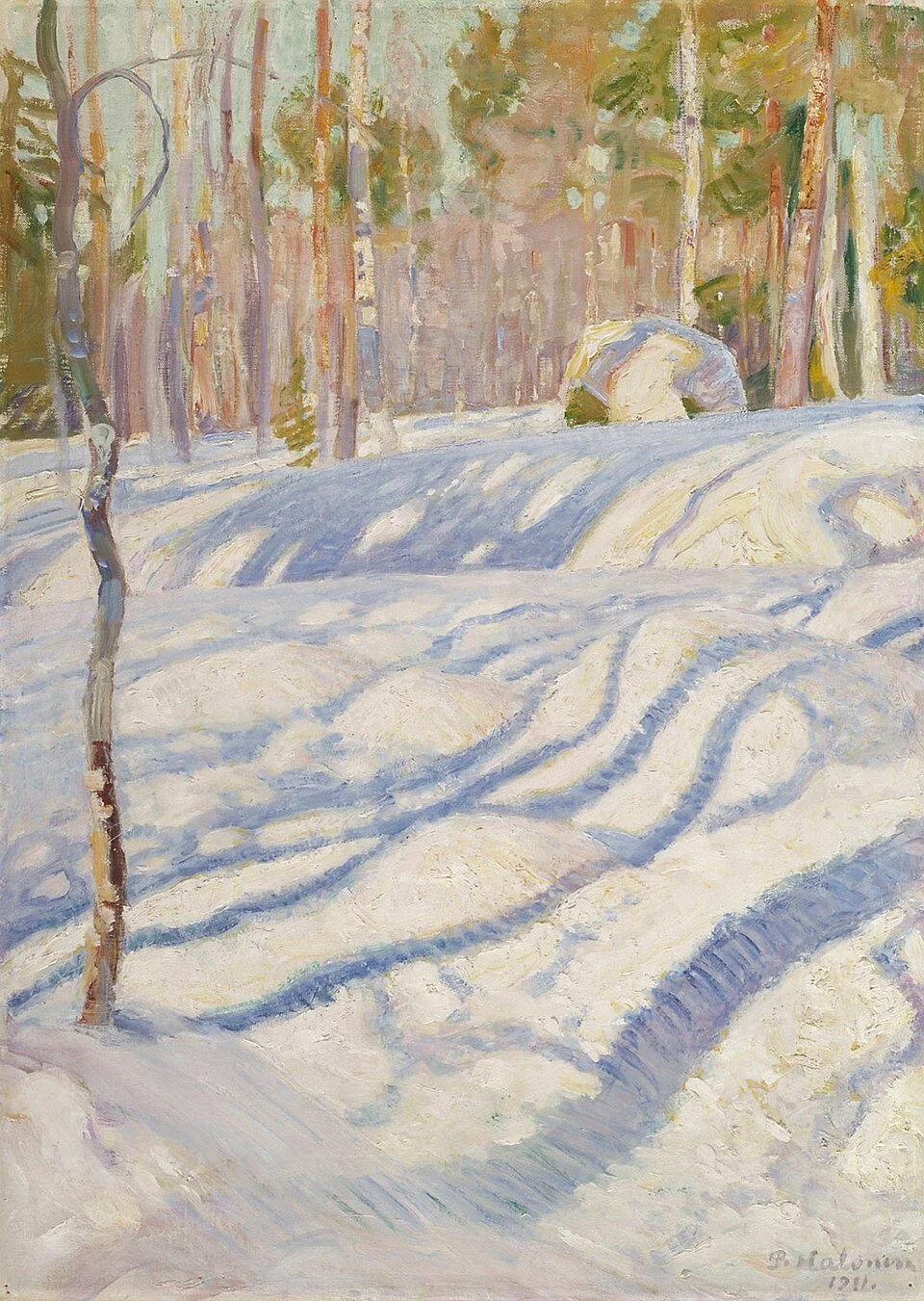
Pekka Halonen’s 1911 painting Soligt vinterlandskap, or Sunlight Winter Landscape. Like Sibelius and Gallen-Kallela, Halonen was also deeply inspired by the Kalevala and produced art depicting it.
There are great artists of all kinds, who have come to see the artistic process as a type of modified role of a medium, where their most inspired ideas are almost given to them, by attendant spirits. The poet Yeats is perhaps most famous for this point of view, but it connections to the idea of having a “genius” (an attendant spirit) for something, and at times in my reflections on Tapiola, I have come to think of these ideas. Sibelius frequently went on walks to organize his compositional thoughts, communing with Tapio, the spirit-king of the forest, to freshen up his ideas. It is interesting to note that Tapiola was Sibelius’s last major work, and after its completion, a period of compositional barrenness followed. He worked for years on an eighth symphony, but was unhappy with the long process and ended up destroying the drafts. I can imagine how often he must have taken walks during the period of writing the eighth symphony, and how ultimately, these walks couldn’t give him what they previously had given him. It makes me think that after Tapiola, the sprites of the forest had withdrawn from Sibelius. It reminds me of an ancient type of tale, the man is given riches or power, but most only not share it, and inevitably he does. Tapiola was the last magnificent strike of lightning in the composer’s life, and despite his best effort, he was not to create more great works of genius. I wonder if he had felt tangibly that the creative spirit of the woods had left him. I wonder if in revealing Tapio for who he is, he had, like Prospero, unwittingly broken the staff and book that gave him his powers as an artist. And I wonder what it must have felt like to be on those forest walks, and to realize that the ideas in his head were remaining shapeless and half-formed.